

Introduction
Data governance is no longer a manual activity managed through spreadsheets scattered policies and reactive audits. Modern enterprises generate massive volumes of data across teams platforms and geographic locations. When governance depends on people alone risk increases and enforcement becomes inconsistent. Artificial intelligence changes this dynamic by automating compliance validation ownership controls and quality checks. AI in data governance turns governance from a cost center into an active value driver.
Why AI Matters in Governance
Governance frameworks often fail because they rely on human intervention. Analysts discover problems after they reach dashboards regulators identify gaps after reporting and executives respond only when incidents occur. AI governance systems work continuously. They detect anomalies classify records enforce access controls and validate compliance without waiting for human action. This creates a proactive governance model.
Core Capabilities of AI Driven Governance
Automated classification AI models identify sensitive financial operational or personal data automatically removing the guesswork from tagging.
Real time anomaly detection Machine learning models flag suspicious updates inconsistent metrics or irregular activity as it occurs.
Policy enforcement AI ensures access rules encryption standards and retention requirements are followed consistently.
Continuous auditing Instead of quarterly or annual reviews AI systems monitor usage and track compliance around the clock.
Business Benefits
Organizations using AI governance gain
- Higher trust in analytics output
- Reduced risk and regulatory exposure
- Faster remediation of quality issues
- Improved operational efficiency through automation
Governance becomes embedded into infrastructure rather than an afterthought.
Implementing AI Governance
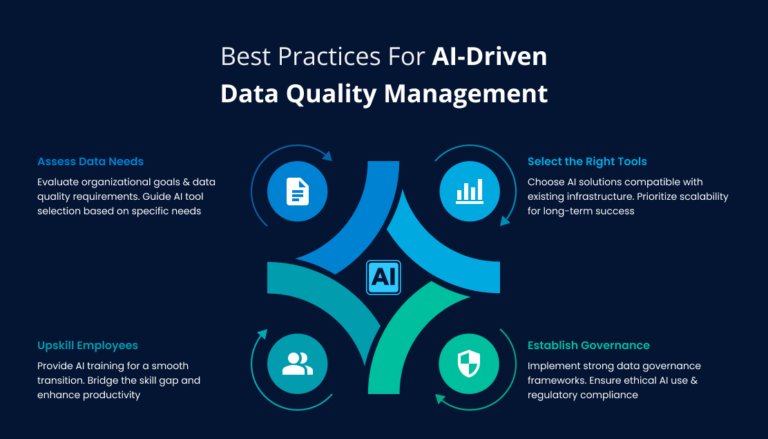
Start with standardized definitions A shared data dictionary makes it easier for AI to classify and validate information.
Integrate with data pipelines Governance must run at ingestion transformation and access points.
Deploy anomaly models Use ML models to detect unusual patterns in usage and quality.
Centralize monitoring A single dashboard provides visibility into compliance performance and data health.
Best Practices
- Train systems with domain specific examples
- Review alerts periodically to prevent false positives
- Document automated rules for audit compliance
- Educate teams on governance automation
Frequently Asked Questions
Can AI replace governance teams No. AI enhances governance by handling repetitive monitoring. Strategic oversight remains human led.
Does AI guarantee zero compliance breaches It reduces risk significantly but needs maintenance and clear policy definitions.
How long before results are visible Enterprises typically see reduced manual work and improved data quality within three to six months.
Conclusion
AI is transforming data governance from reactive maintenance to proactive control. Enterprises that automate governance become faster more secure and more resilient. Ignoring automation increases risk and slows innovation.
Call to Action
Enhance your data governance with AI automation. Visit https://dataguruanalytics.org/data-infrastructure-consulting to build intelligent governance for your enterprise.