
Blog Content
Introduction
Enterprises have never had more data, but they have also never struggled so much to use it. Data trapped in warehouses, ERPs, CRM tools, cloud platforms and legacy systems creates fragmentation. Traditional integration models demand extraction, duplication and transformation before analytics can begin. Data virtualization solves this problem.
Instead of moving data to a central location, it allows teams to access it where it lives.
Data virtualization benefits executives because it accelerates insights, reduces engineering overhead and removes costly migrations. It enables real time access to enterprise data systems without physically combining or duplicating them. The result is faster decision making and lower infrastructure risk.
What Is Data Virtualization
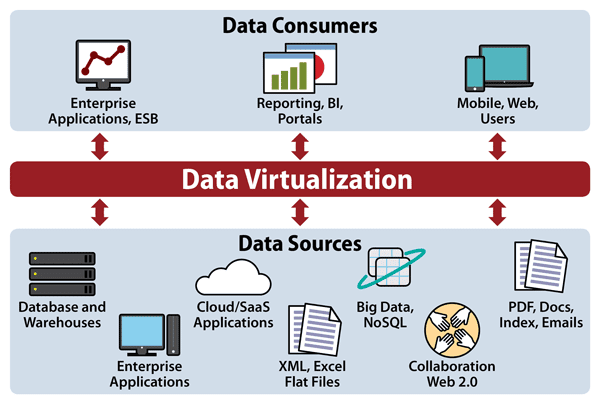
Data virtualization is a technology layer that connects analytics tools to distributed data sources. It does not copy or relocate data. Instead, it provides a unified view so analysts and applications can query data in real time.
A virtualization layer typically includes
- Source connectors across cloud, warehouse and on prem systems
- A semantic model that defines business meaning
- Security and role based access
- Query optimization for performance
Executives should view virtualization as a strategic access model. It eliminates complex data movements and speeds up operational decisions.
Why Enterprises Need Data Virtualization
There are three business realities driving demand.
1. Data sources keep multiplying
CRMs, billing platforms, IoT sensors, supply chain tools, risk dashboards and AI services all generate data. Virtualization unifies them without migrations.
2. Speed matters more than storage
If insights arrive late, they lose relevance. Virtualization minimizes latency by eliminating ingestion bottlenecks.
3. Infrastructure must evolve without disruption
Virtualization allows modernization over time. You can improve storage or architecture without stopping analytics.
Core Data Virtualization Benefits for Enterprise Leaders
1. Real Time Access Across Systems
With virtualization, analysts do not wait hours or days for ETL jobs. They interact with live data across platforms.
Executives get real time dashboards that reflect current sales, fraud behavior or market volatility.
2. Lower Infrastructure Cost
Virtualization removes the need to constantly copy data into new lakes or warehouses.
Storage costs decline because virtual views replace duplicated tables.
3. Faster Time to Insight
Data teams no longer spend weeks building integrations. Projects begin from day one.
Marketing, finance and operations see immediate value.
4. Reduced Migration Risk
Migrating entire data estates is risky and expensive.
Virtualization allows gradual modernization instead of big bang cutovers.
Executives exploring modernization strategies can reference
https://dataguruanalytics.org/data-infrastructure-consulting
Virtualization vs Traditional Integration
Traditional integration relies on ETL and replication. Although it is useful, it creates new technical debt every time data moves.
ETL requires
- Ingesting data through pipelines
- Transforming schemas
- Maintaining copies of information
- Rebuilding flows when sources change
This model does not scale well. Every new source requires engineering and rework.
Virtualization avoids this.
A single semantic layer connects to new systems with minimal disruption.
It enables agility, not repetition.
Data Virtualization and Governance
Virtualization is not a bypass for governance. It enhances it.
Because data stays at the source, lineage is preserved, access rights are enforced and compliance becomes simpler.
A governed virtualization layer ensures
- One definition of metrics
- Role based visibility
- Source level audit logs
- Policy enforcement for sensitive data
Executives should connect virtualization to governance frameworks, not treat it as a shortcut.
Explore validation and policy alignment at
https://dataguruanalytics.org/data-quality-validation-solutions
Virtualization and AI
Virtualization provides AI systems with richer, more diverse training data.
Instead of sending static tables to model teams, virtualization offers dynamic access to many signals at once.
This allows
- Faster feature engineering
- Multi dimensional customer modeling
- Improved anomaly detection
- Cleaner input for credit, fraud and pricing models
If AI is the engine of digital transformation, virtualization is the fuel pipeline.
Real Enterprise Example
A global logistics company needed to unify IoT sensor data, warehouse inventory, ERP records and customer service logs. Traditional integration required months of ETL builds.
Instead, they used virtualization to create a single operational view.
Results included
- Faster delivery predictions
- Reduced database duplication
- Warehouse performance insights in real time
- A foundation for predictive maintenance
They modernized without rewiring their entire data system.
When Virtualization Works Best
Virtualization is ideal when
- Business units require real time analytics
- Migration projects are long and costly
- Teams struggle with siloed KPIs
- Legacy systems cannot be replaced quickly
- Multiple clouds and on prem systems coexist
The model is not limited to large enterprises. Mid market companies benefit immediately because they often cannot afford large scale rebuilds.
Frequently Asked Questions
Does virtualization replace data warehouses
No. It works alongside them. Warehouses store data. Virtualization provides access without duplication.
Is virtualization slower than direct warehouse access
Not when implemented correctly. Optimization engines push computation to the source.
Can virtualization support compliance
Yes. It simplifies compliance by keeping data where it is governed rather than duplicating it.
Conclusion
Data virtualization benefits enterprise leaders because it delivers access without restructuring. It reduces infrastructure cost, eliminates data silos and accelerates analytics. Instead of forcing full migrations, it enables modernization at the pace the business requires. Organizations that adopt virtualization do not react to data—they use it the moment it matters.
Call to Action
Build virtualization enabled analytics systems designed for speed, security and growth. Begin with architecture planning at
https://dataguruanalytics.org/data-infrastructure-consulting and give your teams real time access to enterprise intelligence.